
IBPS AFO Mains Descriptive Test: Why It Matters
Most IBPS AFO aspirants spend almost all their Mains preparation on Professional Knowledge, and that makes sense, because the merit list is based on it. But the Descriptive Paper (English) is compulsory and qualifying. If you don't qualify it, a great Agriculture score will not help you.
The good news: the Descriptive Paper is one of the easiest papers to prepare for in the last two weeks. You don't need fancy English. You need a clear format, simple correct sentences, and a few habits that examiners reward. This guide covers how to score well and the common mistakes that cost aspirants marks.
IBPS AFO Mains Descriptive Paper 2026: Pattern at a Glance
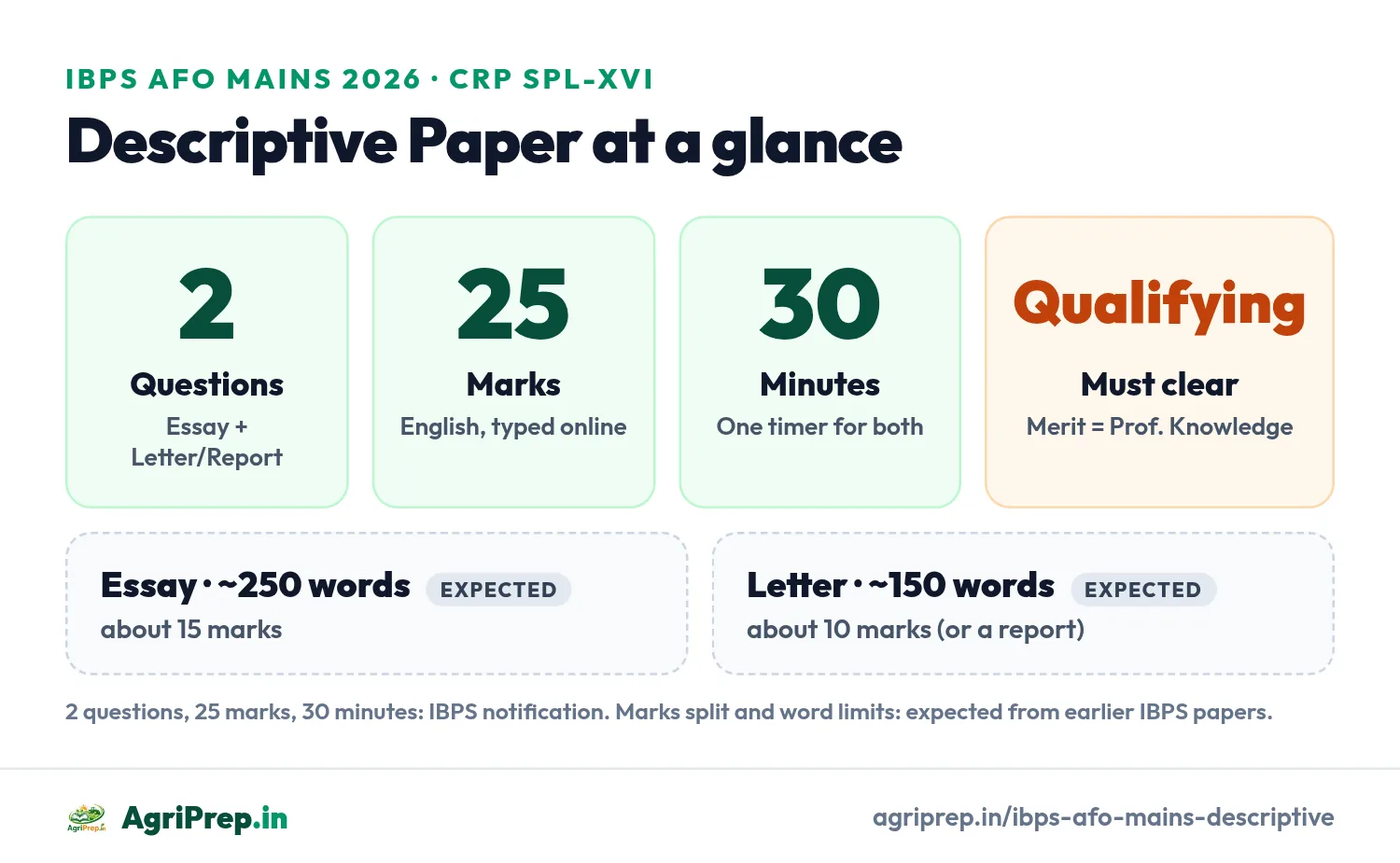
| Particular | Details |
|---|---|
| Questions | 2 (usually 1 essay + 1 letter or report) |
| Total marks | 25 |
| Time | 30 minutes for both answers |
| Mode | Online, typed on a computer, in the same sitting as the objective Mains tests |
| Nature | Qualifying (merit is decided by Professional Knowledge) |
| Marks split (expected) | Essay about 15 + Letter/Report about 10 |
| Word limits (expected) | Essay about 250 words, Letter/Report about 150 words |
How the Descriptive Paper Is Marked
IBPS does not publish its marking scheme. But every descriptive answer is judged on the same few things, and if you cover these, you will be safe:
| What examiners look for | Essay | Letter / Report |
|---|---|---|
| Relevance | Answers the exact topic, with real points and examples | States the purpose in the first lines and covers every point asked |
| Format & structure | Introduction → 2–3 body paragraphs → conclusion | Correct letter or report format, short paragraphs |
| Grammar | Correct tenses, articles, agreement and punctuation | Same |
| Vocabulary & tone | Simple, precise, formal English | Formal or informal as the question asks |
| Word limit | Close to the limit, not far above or below | Same |
How to Score Well: Step by Step
1. Split your 30 minutes before you start
There is one timer for both answers, so plan it:
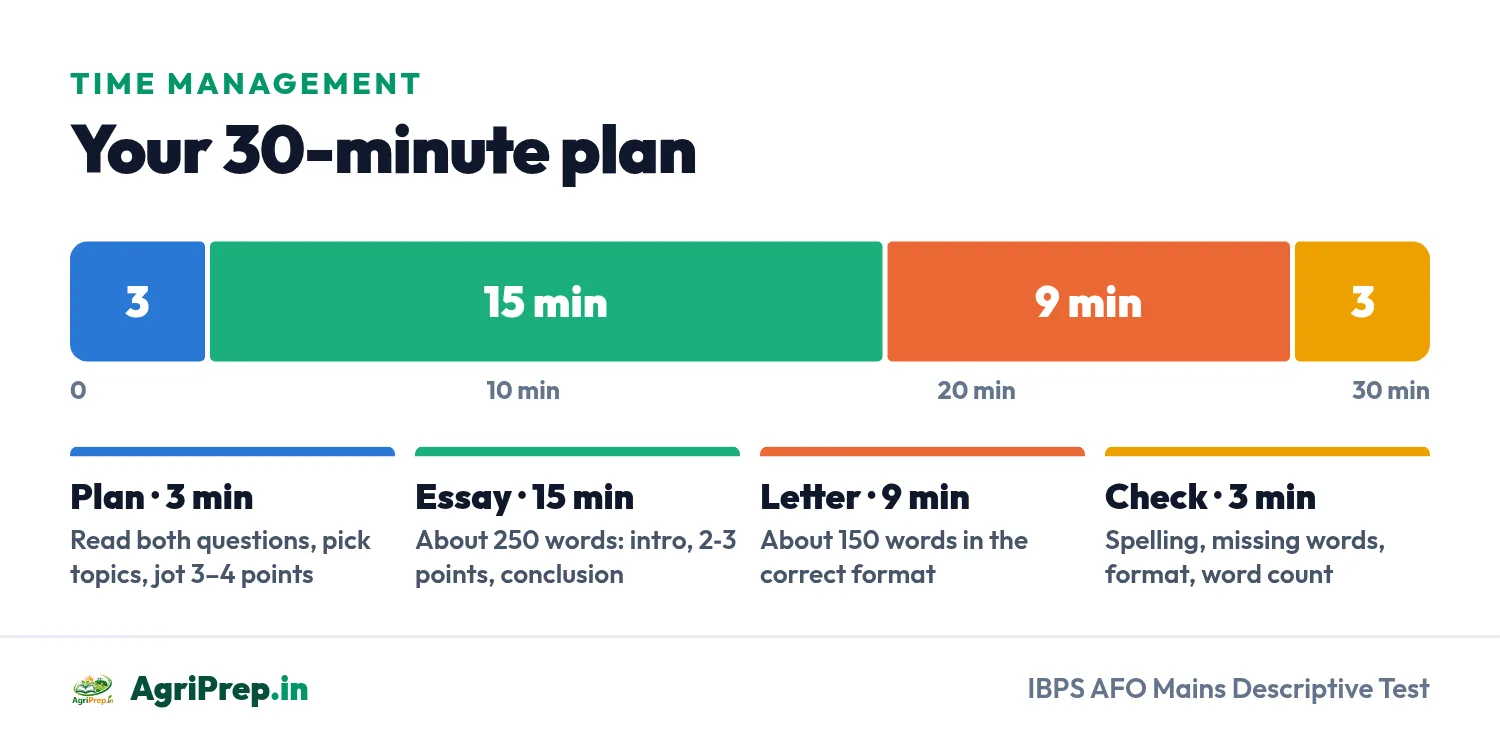
If the letter carries fewer marks, don't let the essay eat its time. A complete letter with the right format scores better than a half-written one.
2. Use a fixed essay structure
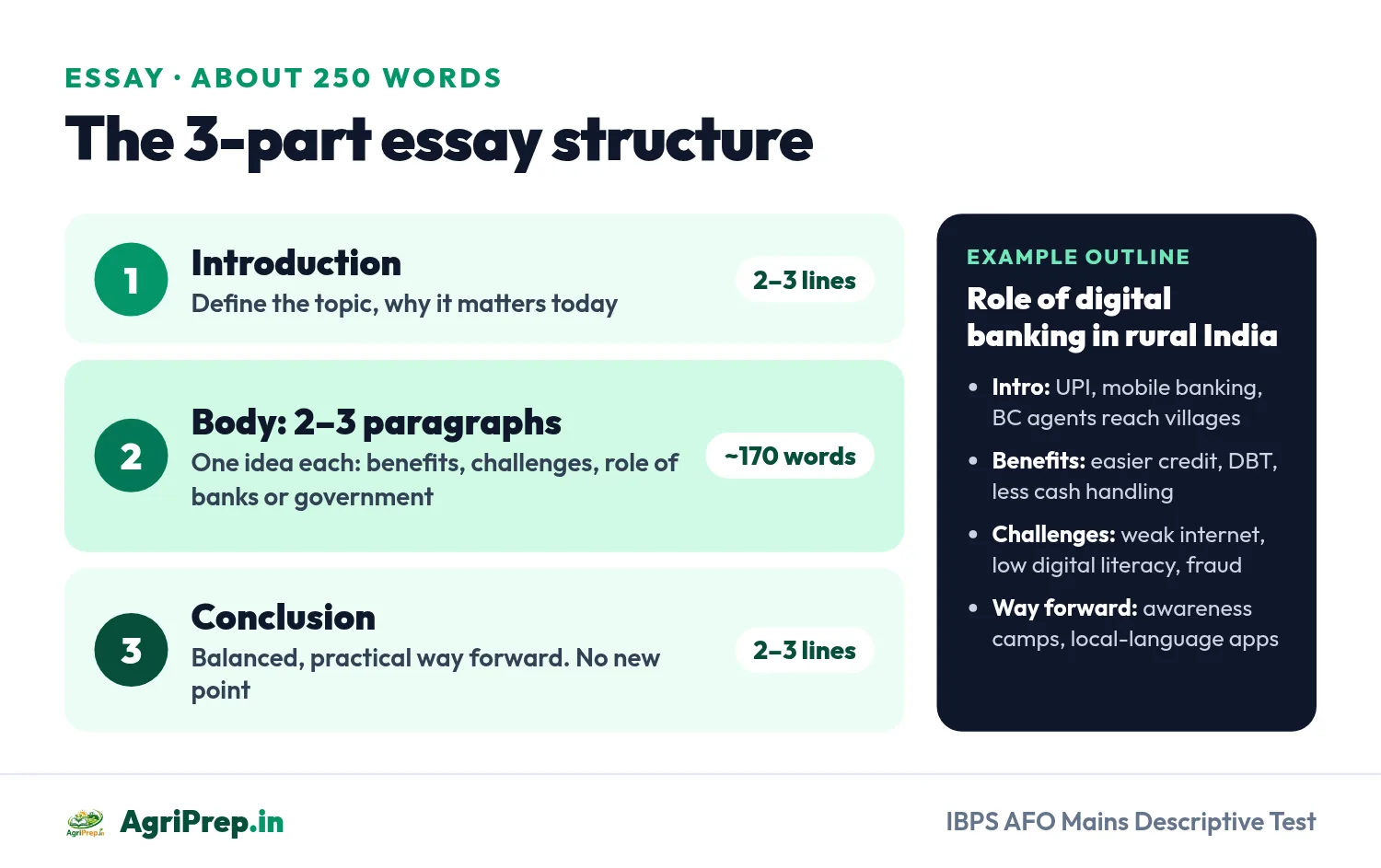
- Introduction (2–3 lines): define the topic and say why it matters today. One fact or recent development is enough.
- Body (2–3 paragraphs): one idea per paragraph. For example: benefits, challenges, and the role of banks or government.
- Conclusion / way forward (2–3 lines): a balanced, practical solution. Never end with a new point.
Example outline: "Role of digital banking in rural India"
- Intro: rural customers now use UPI, mobile banking and banking correspondents.
- Body 1: benefits: easier credit, direct benefit transfers, less cash handling for farmers.
- Body 2: challenges: weak internet, low digital literacy, fraud risk.
- Body 3: what banks can do: awareness camps, BC agents, simple local-language apps.
- Conclusion: digital banking works best when trust and training grow with it.
3. Get the letter format exactly right
Format marks are the easiest marks in the paper. A formal letter should have:
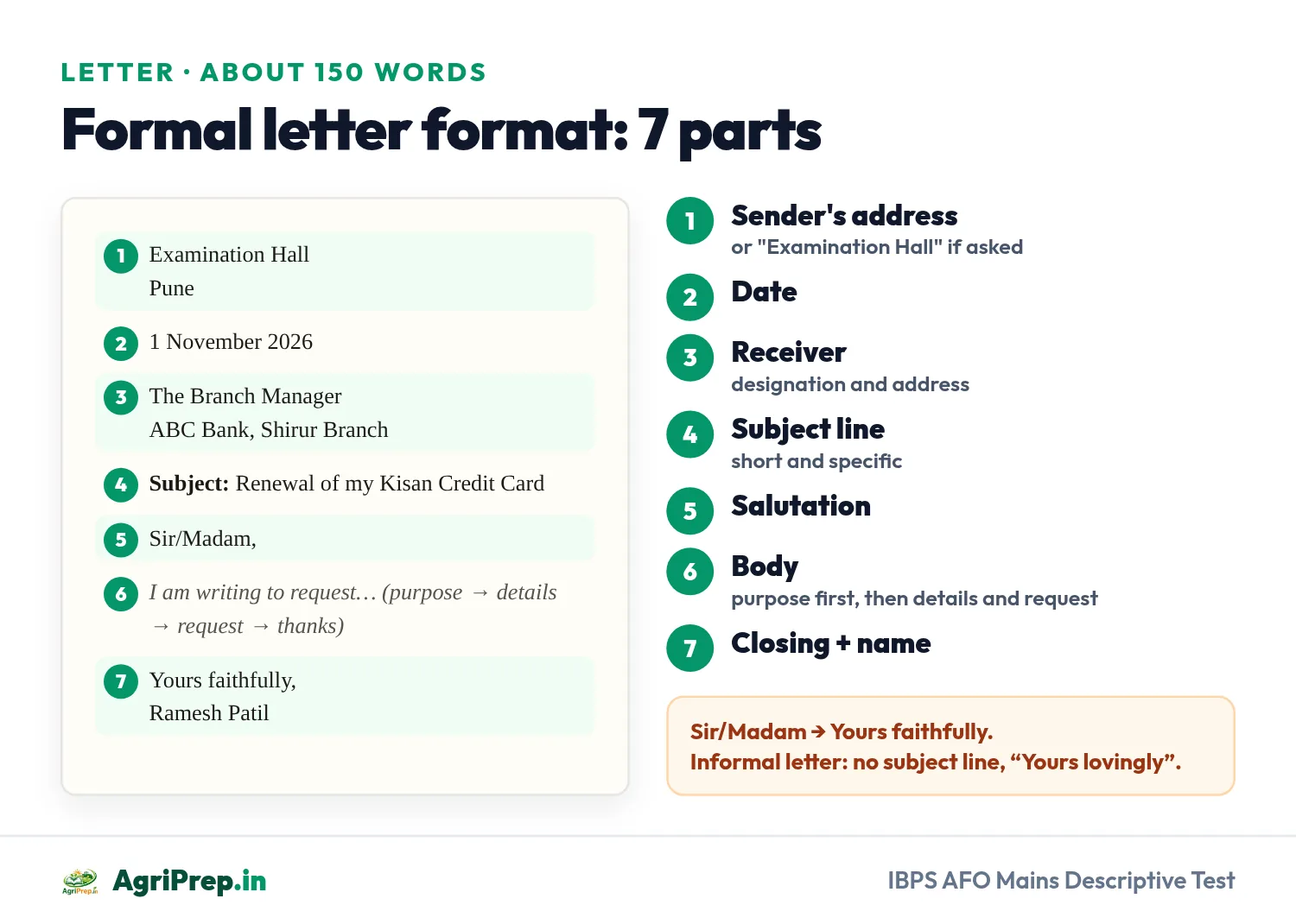
- Sender's address (or "Examination Hall" if the question says so)
- Date
- Receiver's designation and address
- Subject line (short and specific)
- Salutation: Sir / Madam or Dear Sir/Madam
- Body: purpose → details → request or action → thanks
- Closing: Yours faithfully (formal) and your name
For an informal letter, drop the subject line and the receiver's address, use Dear Ravi, and close with Yours lovingly or Yours affectionately. For a report, use a title, "Prepared by / Date", and sections such as introduction, findings, recommendations and conclusion.
4. Bring in your Agriculture and banking knowledge
As an AFO aspirant you already know more than most candidates about Kisan Credit Card, crop insurance, soil health, FPOs, irrigation and rural credit. Use one or two correct, specific points from this knowledge. A single relevant example ("a farmer with a KCC can draw short-term crop loans as needed") is worth more than a paragraph of general sentences.
5. Write simple, correct English
Short sentences of 12–20 words are safer than long ones. Use the vocabulary you are sure of. Examiners reward clarity, not difficult words.
6. Practise typing, not just writing
The paper is typed on a computer. Practise at least 4–5 timed answers on a keyboard so you know your real typing speed. Type as if there is no spell-check, and keep the last 2 minutes for proofreading.
Common Mistakes to Avoid in the IBPS Mains Descriptive Test
| Mistake | What to do instead |
|---|---|
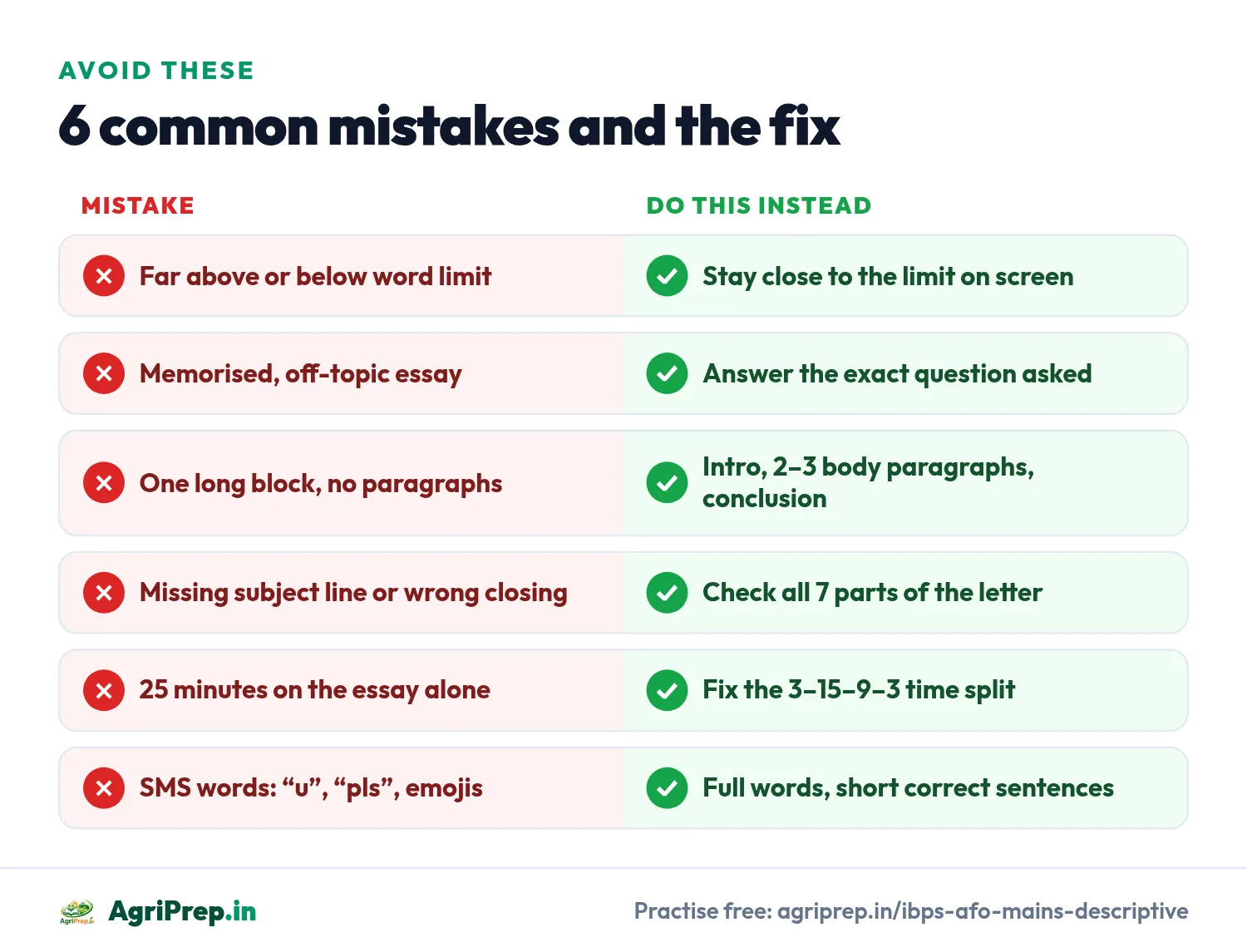
| Writing far above or below the word limit | Stay close to the limit shown on screen. Very long answers waste time; very short ones lose content marks. |
| Going off-topic or writing a memorised essay | Read the exact question twice. Answer what is asked, even if you prepared a similar topic. |
| No paragraphs | Use an introduction, 2–3 body paragraphs and a conclusion. One idea per paragraph. |
| Wrong letter format | Check: date, subject line, salutation, closing. Sir/Madam goes with Yours faithfully. |
| Wrong tone | Formal letter to a bank manager or official: polite and professional. Informal letter to a friend: warm, but still correct English. |
| Spending 25 minutes on the essay | Fix your time split before you start and move on when the essay time is over. |
| SMS language and slang | No "u", "pls", "gonna" or emojis. Write full words. |
| Grammar slips: articles, tenses, subject-verb agreement | Keep sentences short. In your final check, read for a/an/the, -s/-es endings and tense consistency. |
| Long introduction, weak ending | Keep the introduction to 2–3 lines. End with a clear conclusion or way forward. |
| Wrong facts or made-up numbers | Use only facts you are sure of. A wrong statistic hurts more than no statistic. |
| Ignoring the paper because it is "only qualifying" | It is compulsory. Give it at least 4–5 practice answers before the exam. |
Last 10 Days: A Simple Practice Plan
- Days 1–3: learn the formal letter, informal letter and report formats. Write one of each.
- Days 4–7: one essay + one letter daily within 30 minutes, typed. Check word count and time.
- Days 8–10: full timed papers. Read your feedback and fix the one mistake that repeats most.
Frequently Asked Questions
Is the IBPS AFO Mains Descriptive Paper qualifying?
Yes. As per the CRP SPL-XVI notification, all Mains tests except Professional Knowledge are qualifying. You must clear the Descriptive Paper, but its marks don't decide your rank.
How many questions are in the Descriptive Paper?
2 questions for 25 marks in 30 minutes. Usually one essay and one letter or report.
What is the word limit?
IBPS does not publish it in the notification. Earlier IBPS papers used about 250 words for the essay and 150 words for the letter. Follow the limit shown on your exam screen.
Is it written on paper or typed?
It is an online test: you type your answers on the computer in the same sitting as the objective Mains tests.
What topics come in the essay?
Topics usually relate to agriculture, rural development, banking and current socio-economic issues: the areas an Agriculture Field Officer works in.